Posted in Commercial Van, sprinter commercial van

Sprinter Van Tire Care Tips

Earth Month
Sprinter Van Tire Care Tips

When it comes to keeping your sprinter commercial van in great condition. One of the primaries is to maintain your tires, which are essential elements of any Sprinter van. Because they carry more weight than the average passenger vehicle, the proper care for your tires is even more important than it is for your everyday car. The right tactics here can get you years of additional lifespan from your tires, while inattention to your tires can not only lead to replacements needed far more often, but also potential issues with other components of your Sprinter van. Here are some areas to keep in mind when it comes to your Sprinter’s tires.


Proper Tires

For starters, it’s always important to have the right tires on the vehicle, to begin with. New Sprinter vans always come with properly outfitted tires, as do pre-owned options – if you happen to buy your Sprinter from another used source, however, make sure you check on the tire type in advance. Undersized Sprinter tires will not be as efficient as the proper size, and can also lead to significant balance and alignment issues in some cases.


Inflation Levels

Some people mistakenly think tires can only lose their inflation levels if they have holes or cracks, but this is not the case. Tires will still naturally lose pressure over time, particularly if they are carrying a heavy load on a regular basis. Underinflated tires will wear down faster than others, and they will also put more pressure on your Sprinter’s alignment in the process. Checking tire pressure is simple, with easy-to-use fillers available at most gas stations today.


Tire Rotation

Roughly every 6,000 miles, or even more often if you’re regularly hauling heavy loads, you should have your Sprinter tires rotated. Rotation of tires allows for them to wear evenly, rather than certain tires wearing down faster than others and leading to earlier replacements needed. Tire rotation is key to getting the absolute most out of each tire.


Driving Habits

In general, it’s good to be a cautious and careful driver in your Sprinter. This is for non-tire reasons, of course – you want to protect the quality of your vehicle and avoid any risky situations. But it’s also for the benefit of your tires, which will be in better shape if you avoid areas like debris, potholes and any high curbs. Any objects you run over with tires may damage them, particularly sharp or hard items.

Posted in sprinter commercial van, van insulation

Preparing Your Sprinter Van for a Summer Road Trip

50 Van Life Tips For Living On The Road
Preparing Your Sprinter Van for a Summer Road Trip

Summer is upon us, and for many Utah residents, that means it’s time to prepare for road trip season. And for families or groups who take regular summer trips, a luxury sprinter works van can be the perfect companion.


Charged Battery

For starters, check the battery well in advance of beginning your trip. The last thing you want is to be stuck sitting on the side of the road in the middle of nowhere, waiting for an expensive tow truck to drive hours from the nearest town to give you a jump or change the battery.


Lights and Wipers

To check your sprinter’s lights ahead of the trip, which is vital even if you don’t plan to be driving at night (lights are needed during storms or other adverse weather conditions), you’ll need a spotter for assistance. Have this person stand outside the sprinter as you turn lights on and off in every area – make sure they know which lights are supposed to turn on at which times so there are no errors. Include normal lights such as headlights and taillights, but also fog lights, signal lights and any others.

You’ll also want to check out your windshield wipers. If possible, the best way to do this is simply by driving through some rain. If it’s dry ahead of your trip, splash some water on the windshield and also test the wipers using windshield cleaning fluid from your engine.


Tire Pressure

Like with your battery, checking tire pressure ahead of time prevents the risk of being stuck on the side of the road. Use a basic tire gauge to check the pressure level of all four tires plus your spare, which you should always bring on a road trip. Bring the tire gauge with you on the trip so you can check pressure levels regularly.


GPS and Navigation

Even if you’ve been to your destination before, it’s important to have GPS and other navigational assists present just in case. Luckily, most modern smartphones have built-in GPS systems that will assist you here.

Posted in Commercial Van, Refrigerated Van

Hiring a Refrigerated Truck – The Beginners Guide

What's in Store for Reefer Trucks? — - MJ Truck Nation – MJ Truck Nation
Hiring a Refrigerated Truck – The Beginners Guide

Hiring refrigerated trucks can be a great option for your business, home, or hobby. It’s affordable, flexible, and cost-effective compared to running and maintaining your fleet.

If you’re a beginner in hiring trucks, this article is the perfect place to start. We’ll walk you through our top tips to ensure you have the best experience. 

Shop Around For Your Refrigerated Truck

There are many refrigerated truck hire companies to choose from, but not all have the same quality of service. Take the time to explore different options to find the best deal for you. Remember, the cheapest option may not be such a good idea. Look for a company with a good reputation, modern fleet of trucks, and reliable service. 

Think about Size

It’s important to measure the load you’re going to be transporting and check which size truck you’ll need. There’s no use in having way too much space or squeezing everything in and damaging your goods. 

Check Temperature Range

Another important factor to consider is what temperature your goods need to be transported at, and how sensitive they are to temperature variations. Look for a modern truck, which has all the latest temperature control technology. 

Plan your Schedule

When hiring a truck, you can save money by planning out your schedule. Plan out how long the trip will take, including stopping for fuel and breaks. Choose a company with flexible hire options for the easiest answer. 

Posted in Commercial Van, sprinter commercial van, sprinter work van

Benefits of sprinter commercial van

Benefits of sprinter commercial van

Choosing a van for your camper can conversion is your first important step when taking the leap towards living in a van. There are many types and models of vehicles out there, and the best one for you really depends on your needs and wants.

Some vans are better for extra space, some are better for stealth camping, some are more cost-effective. If you’re reading this page, chances are you plan to build out your van yourself. But if you want something already converted that will take minimal work to get on the road, there are options for that, too.

To help you choose the right van to live in, I have put together an infographic with pros and cons of some of the most common types of vehicles out there on the road. 

Sprinter commercial van is especially known for its interior height, long wheelbase, and boxier shape making them ideal for building out spacious, functional living space. This category includes the original Mercedes/Dodge Sprinters, as well as Ford Transits and Dodge Premasters.

Sprinter van options include the Sprinter cargo van, passenger van, cab chassis, and crew van. Prices for base model Sprinter vans start in the mid-$30K range. Gross vehicle weight ratings for Sprinter vans range from 8,550 to 12,125 lbs. A sprinter van is the perfect addition for transporting long equipment. If you transport ladders, pipes, or other long equipment, then this type of rack will ensure you do it safely and effective.

Considering all the factors , you have a much higher chance of picking the perfect sprinter van for your business. With the right solution in your hands, you will be able to meet the increased demands that the summer has brought, ensuring the products you send to your stores, customers, and more reach them safely.

Posted in Uncategorized

The Best Car Floor Mats and Liners

Vantred Van Mats | Cargo Van Mats - BedRug | Bedrug
The Best Car Floor Mats and Liners

The daily grind of shoes, mud, crumbs, and spills can take a toll on a commercial van’s carpet, creating a messy eyesore and dragging down your vehicle’s resale value. That’s why a good floor mat or liner can pay for itself over time.

After over 100 hours of researching dozens of models, talking with experts, and testing 23 sets, I recommend Weather Tech Floor Liners. Unlike typical add-on liners, they’re designed to fit specific vehicles and have raised edges that trap liquid. 

WeatherTech Floor Liners provide edge-to-edge coverage of a vehicle’s foot wells that better protects the carpets from water, snow, muck, and other messy things that can get tracked into the vehicle or spilled onto the floor.

In addition, compared with other similarly priced liners I looked at, the WeatherTech Floor Liners include a taller, more pronounced lip around the edge—particularly at the rear—as well as a pattern that channels fluids away from your feet to a reservoir at the rear. They also come in a far wider range of fits than any other liner, with designs for more than 1,000 vehicles.

If you want a custom-fit floor mat but don’t want to spend the money on a premium liner, we recommend the Intro-Tech Hexomat, which splits the difference in cost and coverage between a universal mat and a model-specific liner.

The Hexomat lacks the higher side walls of liners like our top pick, but it does provide wall-to-wall footwall coverage and a design that helps contain spills.

If you just want an inexpensive, basic universal floor mat to provide some protection for your van’s carpet or spruce up an older van on a tight budget, I liked the Motor Trend Odorless Rubber Floor Mats best.

They have a look and feel that belies their low price, and a relatively flat design that makes them easier to clean than more aggressive-looking mats I tested. But like other inexpensive mats, they tended to move around more than I would like and will require periodic adjustment to keep them in place.

Like all traditional mats, they also lack the high side walls and precise fit of our top pick, and therefore don’t provide the same wall-to-wall coverage and protection.

Posted in sprinter commercial van, sprinter work van

Adding sound and heat insulation to the floor

2016 Ford Transit 250 Medium-Roof Van Review - AutoGuide.com
Adding sound and heat insulation to the floor

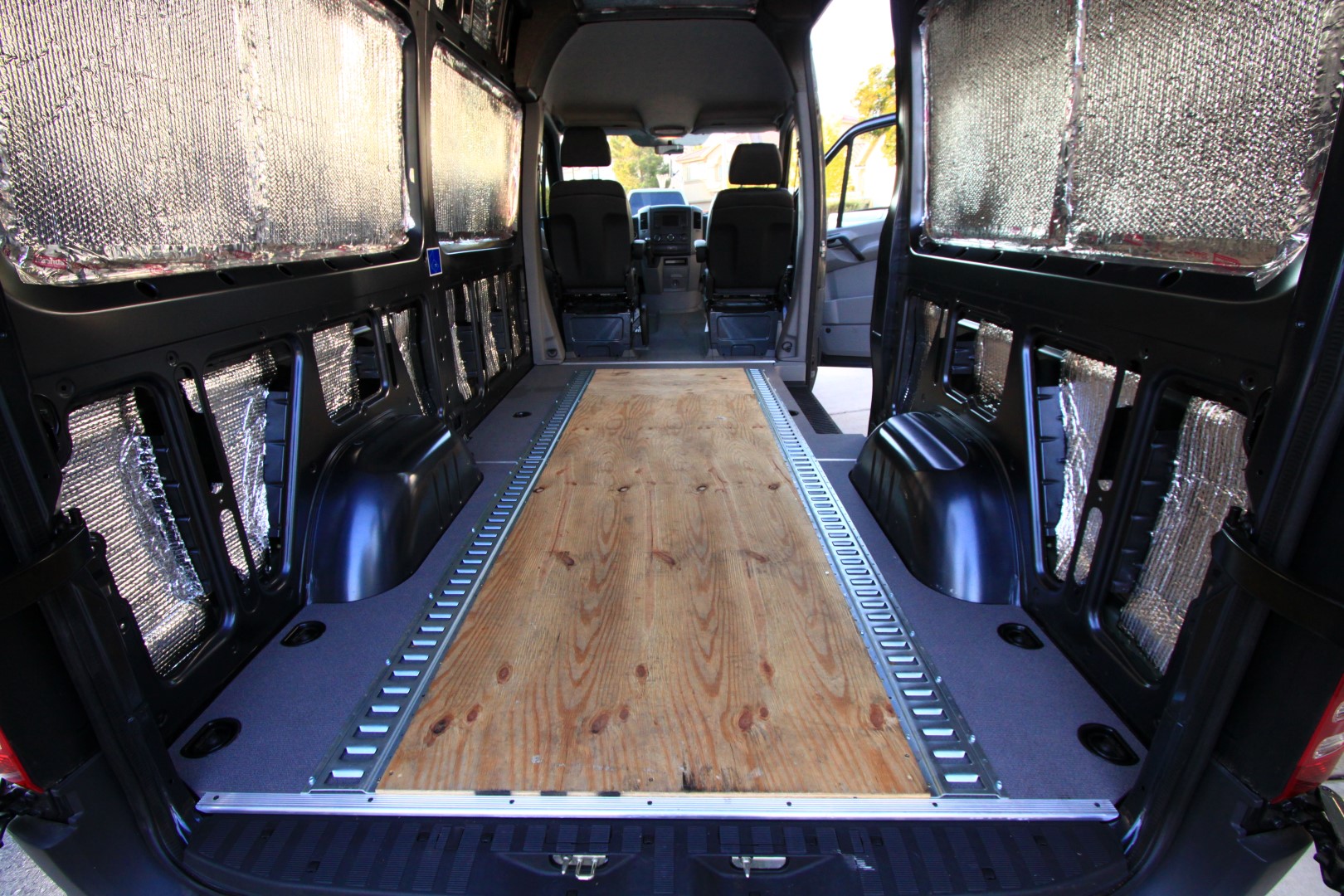
Horse stall mat, vinyl coin matting and closed cell foam make a good sound damping combination over the factory wood floor of the sprinter commercial van. Flanged l-track holds the three layers in place.

I Painted the metal van floor and reinstalled the wood floor with some closed-cell foam underneath it. That wasn’t enough insulation though.

For a combination of heat and sound insulation, I went with a layer of closed cell foam (Low-E foil faced 1/8″ foam), 3/8″ rubber stall mat and 2mm (~1/16″) hard-wearing non-slip vinyl coin-grip flooring.


Each of these layers serves a different purpose. The closed cell foam is a heat insulation layer and it also lets the stall mat float freely above it. This makes the stall mat into a great sound dampening layer.

Car audio fanatics use mass loaded vinyl in a similar way. The stall mat has a similar density to mass loaded vinyl but is much thicker. The non-slip vinyl layer on the top provides some protection for the floor and is more visually appealing than the rubber stall mat.

All of these products come in four foot widths, but the van floor is around six feet wide. To hold the three layers down without needing to glue them in, which would ruin the sound dampening effect, I ran strips of l-track from the front to the back of the van about 12″ in from each wall. This lines up really nicely with one of the raised areas in the metal floor.

You can get l-track installed in the van from the factory, but that is recessed into the wooden floor and glued in place. I wanted our l-track to sit on top of the wooden floor. The space behind the flanges is 1/2″. That’s just right for the three layers of flooring material I use when they are compressed together. The flanges of the l-track hold the layers in place really firmly.

I bolted the l-track through the wooden floor, through the metal base of the van, and through Unistrut steel channel under the van to add strength to the bolts and also to provide a mounting point for anything I want to attach under the van.

The floor feels firm to walk on but slightly cushioned. It cuts down considerably on the road noise coming in to the van. There are some wrinkles in the top coin layer from where it was rolled up so tightly but they are smoothing out as I use the van.

Posted in Commercial Van, sprinter commercial van, sprinter work van

The Best Campervan Flooring and Top Installation Tips

Van Conversion: Floor Layers and Materials – Bearfoot Theory
The Best Campervan Flooring and Top Installation Tips

You bought your sprinter commercial van and are finally ready to begin building. One of the first things you will want to do is start on your campervan flooring. Your flooring consists of a few parts; metal van floor, sound dampener, insulation, plywood floor. Each part of your flooring is important as it is the base for building the rest of your van. 

We have built out two large cargo vans, the first being a sprinter, and the second a Ford Transit. For our Sprinter van flooring, we made a few mistakes, and now while working on our campervan flooring for the Transit we were able to try new methods and see how well they work. 

From the best campervan flooring to installation, learn the methods that we used for our campervan flooring plus optional methods that might work for you.

Types of Campervan Flooring

First, you need to consider what kind of flooring you want to have in your campervan. Once you have a subfloor, my recommendation is to wait until the build is mostly finished before adding your top van flooring.

I say this for a few reasons; one being to save your floor from scratches or paint, the next being that you don’t need nice flooring everywhere since there will be a bed or cabinets on top of it anyway, and the third is you will substantially save money by only putting flooring where you can see it. Not to mention, if you ever want or need to change out your flooring, it will be an easy fix as you will have access to the flooring. 

There are a few types of flooring that are available for your campervan. These are the more commonly used flooring options and the ones I would recommend.

Life Proof Vinyl Flooring (Our Recommendation) 

We recommend vinyl flooring for campervan flooring for many reasons. It’s waterproof which is super important in your van flooring because you don’t want to risk the floor molding.

Mold in a small area will quickly become problematic and could even cause rust, not to mention the health effects mold can have on you in such a small area. Vinyl flooring is also known for high durability and on the road, you will be in and out of your van, in the rain, mud, sand and possibly with dogs wearing on it. Therefore you need something durable for your vanlife flooring. 

In our Sprinter van flooring, we used a random brand of vinyl flooring. After a year it had scratches, cracks at the seams, divots and needed to be replaced. This time around we decided to go with LifeProof vinyl flooring as it is much thicker and known for its durability. We also know vanlifers who have used this flooring and it seems to last much longer. 

Pros: 

  • Most durable option
  • Waterproof
  • Easy Installation
  • Scratch Resistant (LifeProof brand)

Cons: 

  • Most expensive option
  • Can off-gas

Non-Toxic Cork Flooring

Cork flooring is another van build flooring options that some people choose on the road. The main reason being that it is non-toxic which if you have any health problems, then this may be a must for you. It is mold resistant, doesn’t off-gas, and is durable. 

A plus is that cork is a sustainable option. 

Pros: 

  • Non-Toxic
  • Sustainable
  • Cheaper Option

Cons:

  • Pets can more easily damage flooring with nails
  • Needs sealer on top to prevent damage
  • Spills can stain flooring if not quickly wiped up 

Rubber Flooring

A very easy to install campervan flooring option is rubber coin grip flooring. This is a great option to use in your garage or on your entire floor build if you are an outdoor enthusiast. If you will be constantly surfing, snowboarding, or biking and are worried about wear and tear on your flooring then this might be a great option for you.

Pros:

  • Durable
  • Waterproof
  • Cleans easily

Cons:

  • Not super stylish – Honestly comes down to aesthetics
  • If there is a tear, you would have to replace the entire floor
  • Possibility for moisture to form under mats which can mold and rust the flooring

Laminate Flooring (Not Recommended)

Laminate flooring is another option we have seen in the vanlife community but we personally do not recommend it. I wanted you to be aware of the option but it’s not something we would recommend or use ourselves in the van.

Laminate is essentially the IKEA of flooring, it is compressed wood with a wallpaper-like covering on top of it. It’s not a great choice in general and definitely not a good option for your campervan flooring. 

Pros: 

  • Easy to Install
  • Cheap

Cons: 

  • Not durable
  • Molds Easily
Posted in cargo van, Commercial Van

5 Tips to Help Select the Best Commercial Van Floors for your Vehicle

5 Tips to Help Select the Best Commercial Van Floors for your Vehicle

Protect Your Van’s Floor with a High-Quality Flooring Kit

A high-quality cargo van flooring kit will protect your commercial van floors. Rigid and strong, a van liner protects the floor from scraping, dents, impacts, scratches and spills. Avoid the hassle of making a do-it-yourself floor. You can buy a heavy-duty floor system that’s made to perfectly fit your service van.

Make Sure Your Employees are Safe

A good floor kit also minimizes the chances of your employees slipping in the cargo area. It also helps to prevent cargo from shifting around. Impact and Puncture Resistant high-quality van flooring kits provide added safety and a quieter ride.

Select a Surface that is Easy to Clean

A good stable floor gives your technicians a durable surface to work on that is also easy for them to clean. Look for van floors with a non-porous surface that are liquid-resistant to eliminate bacteria and mold formation.

Always Look Professional

Give your work vehicle a clean, professional look that is easy to maintain. Commercial van floors that have aluminum sills add a nice finishing detail, and they give a crisp look to the van floor covering.

Choose Van Floors that are Durable

You will probably want van floors that are made of very high quality, eco-conscious rubber and are guaranteed for the entire time you own your vehicles. You can choose from rigid floors and extremely rigid floors. The best van flooring systems are built to resist cracking and splitting.

Ideal for Fleets

By installing sprinter commercial van flooring in combination with other accessories , your vehicles will have the most complete and professional look in vehicle upfitting. Don’t forget, a quality flooring system will enhance the resale value of your vehicles at lease end.

Posted in cargo van, Commercial Van, sprinter commercial van

Why Are Vandwellers Choosing The Sprinter Camper Van?

https://d2uhsaoc6ysewq.cloudfront.net/48770/Cargo-Vans-Ford-Transit-Connect-XL-19519590.jpg
Why Are Vandwellers Choosing The Sprinter Camper Van?

More and more full-time vandwellers, people living the weekend warrior life and outdoorsy people are choosing the sprinter camper van as their adventure bus. And we can see why, we’ve already shown you some amazing Mercedes sprinter conversions such as the Mercedes Benz Sawtooth conversion, the sprinter conversion moving house and the Sith-style conversion that lets you live the Darkstar van life. So why are so many van life influencers and adventurers choosing the sprinter van over a more traditional RV or something like an airstream camper to be their tiny homes? Read on, and we’ll tell you why.

Why Choose a Sprinter Camper Van?

When you think of sprinter van, it’s likely that a white, dirty and slightly battered builders van is going to come to mind. A workhorse, something practical, durable and reliable, but not something that you’d want to sleep in. However, it is these qualities that make the idea of a sprinter camper van so attractive. The Mercedes makes a practical camper van as it’s so easy to drive. No more struggling up hill or getting stuck on a tight, twisty country lane. No more dreading the drive and just wanting to get to your camping spot as quickly as possible because driving a sprinter camper van is like driving a car, only without the rear view mirror!

Sprinter work van are durable, they’re known for driving hundreds of thousands of miles without a problem. Having a reliable van is so important, and this is another point in favour of the sprinter camper van. Sprinter vans are a globally recognised vehicle, Mercedes produce their cars and vans all over the world, and there is a reason for this, they’re good. Years of experience means they create the best and most popular van there is to offer, so it makes sense to turn it into a camper.

This also means that if you have any problems while travelling in your sprinter camper van the chances that you’re going to be near a Mercedes garage are pretty high, and if not, most garages will stock any parts you might need anyway. 

Sprinter Camper Van Interiors

There is another reason why the sprinter camper van is seeing a recent surge in popularity, and it has nothing to do with the mechanical excellence of Mercedes sprinter camper conversions, or anything to do with how safe and easy sprinter vans are to drive. It is because the sprinter camper van is just, well… cool.  More and more young people want to get outside, to step away from their computers and TVs and to breathe in the fresh air, discover new places and take in amazing views.

Adventuring, exploring and, along with it, ‘motor-homing’ is so desirable right now but motor-homing sounds too old fashioned, too much like something your grandparents would do. So in comes ‘van life’ and, at the heart of it, the sprinter camper van. Van life is so effortlessly cool right now but young adults wanted something different for their off grid adventure than the large, beige, ugly old-fashioned motorhome and they chose the sprinter camper van. 

From the outside, the sprinter camper van is understated and sleek, usually keeping its original working van’s colour of black, white, silver or navy blue. You may come across a unique camper conversion where the outside of the van is a bright, bold colour such as red or yellow, either resprayed or from the vans previous life. And occasionally you’ll see a flawlessly decorated sprinter camper depicting scenes of previous adventures- a mountainscape for example, on the van’s exterior.

What you won’t find on a sprinter camper van are tacky, peeling decals that haven’t stood the test of time and look out-dated and uninviting. The sprinter camper van is too cool for that. Windows and skylights can also be added to any sprinter camper van, either standard ones that come with the vehicle in the side and back doors or something different and personal to your tiny home. Windows bring so much light into the van and make the interior feel so much bigger, but they can also look cool from the outside. Portholes are a popular choice that makes the sprinter camper van look unique from the outside and give the interior a nautical feel. 

Posted in cargo van, Commercial Van, G30 Gas Drive, sprinter commercial van, sprinter work van

How to choose the right panel van for your business

For most small and medium enterprises (SMEs), business growth almost always means acquiring a business vehicle. The question is how to optimise its value to the company when the vehicle is new, and then to determine just when it needs to be replaced, says Datsun South Africa.

Brian Joss – Both questions about buying and replacing a delivery vehicle are critical to SME owners who need to keep a wary eye on cash flow. It is important to ensure that, despite fluctuating fuel prices and the reducing value of the rand, that costs for a business vehicle are kept under control, says Des Fenner, general manager of Datsun South Africa.

“When buying a new delivery vehicle, questions should be asked about three different types of costs. These are the initial price of the vehicle, maintenance intervals and costs, and what expenses can be expected if repairs to the body or engine are required.”

Some key considerations to ensure that these are manageable is by:

*Matching the panel van to its purpose. Consider what it will be carrying, what the mass will be, and how much space will be required. Buying a vehicle that is too small or too large means money being wasted.

*Looking at the acquisition price. Keeping this price down means that cash flow isn’t severely compromised. Also remember that a VAT refund can reduce this price.

*Working out what the van’s average running costs per kilometre are. For instance, in the case of the Datsun Go+ Panel Van, this is R 1.87 per kilometre . Assess the maintenance costs of the vehicle.

*Look at the costs that could be incurred if the van is damaged in an accident or requires major parts.

*Always check insurance costs. The lower the purchase price, and the more affordable parts are, the lower the insurance premium will be.

*Keeping an accurate record of all expenditure on the panel van.

“It’s unwise to assume that because a panel van is small that prices don’t differ much between brands. The Datsun Go+ Panel Van’s price tag is lower than its closest competitors.”

“The same applies to load. The Datsun GO+ Panel Van carries loads of up to

542 kilograms and can swallow loads with a volume of 3.4m3.  For an SME these figures mean fewer deliveries and lower costs per trip,” says Mr Fenner.

“A quick look at the independent Kinsey Report is then recommended. It will tell an SME owner that maintenance and repair costs for the Datsun Go+ Panel Van are the lowest in the country, as it shares the same running gear as the Datsun Go, the car which has held this accolade for two years running.

That’s good news when it comes to maintenance and insurance premiums.”

How to decide when it’s time to replace a panel van depends on many factors, says Mr Fenner. These include: Optimising trade-in price by trading in a van when its value is highest; traditionally, vehicles lose most of their value within the first 12 months and the value then declines more slowly until the end of the second year. Thereafter its value declines more rapidly.

An SME owner who wishes to keep vehicle payments around the same level for as long as possible should bear the ‘two-year rule’ in mind.

Trade-in: trading a van in for a newer model of the same brand usually means getting a better trade in price and having a record of all services and maintenance can also add to this value.

Running costs: noticing when running costs per kilometre begin to increase. This can be because of changing fuel costs, but can also be an indicator that the van needs more attention than it used to. When costs begin increasing rapidly, it’s time to think about trading in.

Mileage: if a van is being used around the clock, its mileage will increase quickly.  Keeping the vehicle for a long period could then rapidly reduce its value. However, if running costs are under control, the vehicle is reliable, and the driver is happy, replacing it becomes a judgement call.

“One of the factors that can rapidly age a vehicle is overloading. Carrying excessively heavy loads places strain on the engine, gearbox, suspension and engine mountings. By making sure that you have bought the correct panel sprinter commercial van and it is fit for purpose, it will be sure to deliver faithful, cost effective service until replaced,” said Mr Fenner.