Camper Van Roof Racks, Ladders, Awnings & Storage Boxes
Once all the necessary aspects of your van build are planned, it’s time to start thinking about van accessories that will make van life even more enjoyable. In this lesson, we’ll cover add-ons and exterior van accessories you might consider and some things to keep in mind, including:
Van roof racks and ladders for your van
Safety add-ons like backup cameras and an in-dash GPS
Air Compressors
The Moonshade is a new, portable, lightweight awning that attaches to the outside of your van (or any vehicle). It stows away when you are driving and helps your van be more discreet if you stealth camp on occasion.
Van Roof Racks & Ladders
A van roof rack needs to be planned out before you install anything else on the roof, like solar panels and a fan. It will need to work around your solar panels and fans or be custom-built to do so, so as you’re planning your solar installation you should be simultaneously planning the rack to accommodate the panels.
Think about what you’ll want to use your roof rack for when deciding what type you want. You may want to use it to hold your solar panels, to store gear, or to have a space on the roof to sit on. One thing to consider is that roof racks add wind noise and make the van less aerodynamic which can reduce gas mileage so keep that in mind.
A ladder rack for van may also be an accessory you’ll want to consider, especially if your van of choice is a Sprinter or other high roof van. Ladder racks make it easier to get up onto the roof to store gear, check on your solar panels, or simply to enjoy the sunset.
Your van might come with a roof rack, but if it didn’t there are many aftermarket companies that make high-quality racks. If a conversion company is converting your van, talk to them about roof and ladder rack options.
Van Backup Camera
Another van accessory you might want to consider is a backup camera. Consider this an essential item if your van is long and/or if you don’t have rear windows. They’re pretty inexpensive aftermarket, but can also be installed by your dealer or conversion company.
Air Compressor
If you do a lot of off-roading, an air compressor is a valuable resource to have in your van. When driving through sand, letting air out of the tires provides more surface area to navigate otherwise tricky sections, ditto for driving on dirt roads, but then you need to refill once you are back on pavement. Having a compressor on board allows you to do this and makes it more feasible to comfortably tackle this type of terrain.
Air compressors can also come in handy for topping off bike tires and for vehicle recovery. When we were off-grid in southern Utah, our friend had a serious flat tire on her van. We were able to use our compressor to blow up her tire enough so she could drive to our campsite where she put on her spare.
What Is Refrigerated Trucking and Why Does Your Business Need It?
What Is Refrigerated Trucking?
Refrigerated trucking is pretty much exactly what it sounds like. When you call on a company to provide you with refrigerated transport services, they will transport your perishable items on a truck that is climate controlled. Depending on what kind of perishables you need to ship, they can set the temperature accordingly.
The vehicles that are used to provide refrigerated trucking are different from the vehicles used to provide other forms of shipping. They’re capable of getting to be very cold inside and can go down to any temperature you want.
They can also withstand the weather conditions outside. This is especially important for those who are transporting perishable items in Florida.
Who Can Provide It?
There are many companies that can provide you with refrigerated trucking. Most trucking companies have refrigerated trucks that are more than capable of handling your perishable items. These companies have plenty of experience when it comes to taking perishable items from point A to point B without a problem.
However, you don’t have to turn to a trucking company to get refrigerated transport services. You should always make sure a company has access to refrigerated trucks before calling on them to transport your perishables.
How Do Companies Provide Refrigerated Transport Services?
Providing refrigerated transport services requires more than just a refrigerated truck. While that’s obviously one of the essential requirements, a company needs to do more than just load up a truck and transport perishable items.
They need to begin by taking inventory of what’s being shipped and deciding the temperature at which to ship it. Then, they need to come up with a plan that will allow them to load up a refrigerated truck quickly to prevent perishables from spoiling before they even make their way into the truck.
Next, they have to monitor the shipment as it’s making its way towards its destination. There may be adjustments along the way that need to be made. And finally, they need to unload the refrigerated shipment just as quickly as it was loaded and make sure the recipient of it is ready to take it on.
By following these steps, a company can successfully ship perishables using refrigerated transport services.
Why Does Your Business Need It?
You’ll usually find yourself in a position where you’ll need refrigerated transport services when you have a large refrigerated shipment that needs to be sent somewhere. Chances are, that shipment is worth a lot of money, and if it falls into the wrong hands, the perishables could end up spoiling and costing you a fortune.
Once you have handed over a shipment to one of the refrigerated carriers out there, you’re at their mercy. They need to be able to take your shipment and send it out to wherever it needs to be in a timely fashion. Otherwise, the shipment could essentially be worthless by the time it arrives.
Your business needs to work with a reliable refrigerated trucking company to ensure this doesn’t happen.
What Are the Advantages of It?
There are so many benefits that you will be able to enjoy when you start using refrigerated carriers.
The biggest benefit is that there is always a high demand for fresh products that have been refrigerated properly. From fruits and vegetables to plants and pharmaceuticals, there is real value in products that are refrigerated.
But that’s far from the only benefit!
One of the other big benefits is that you won’t have to spend a second worried about the weather when you use refrigerated transport services. Whether it’s 100 degrees outside or 0 degrees (not likely in Florida! But…), your perishable items will be in good hands when they’re tucked inside a refrigerated truck.
Additionally, you’ll get the benefit of knowing that your refrigerated shipment will arrive at its destination on time. Companies that provide transport for refrigerated shipments are always going above and beyond to make sure they get to where they’re going as quickly as possible.
Is It Worth the Cost?
There is usually an additional cost that comes along with refrigerated transport services. It’s what makes some business owners rethink using it in the first place.
But if you’re sending out refrigerated shipments, the cost of doing it is something you’re going to have to get used to. You might not like forking over more money to make a shipment. But it’ll be worth it in the end when your shipment arrives successfully.
Keeping refrigerated trucks well maintained and performing at peak operating condition is an important aspect of a reliable cold chain that safely delivers produce, meat, seafood, frozen foods, pharmaceuticals and many other products. A solid maintenance program not only helps protect refrigerated cargo, it also alleviates many unanticipated equipment failures that can lead to the expensive consequences of load losses.
Engineering and design improvements have made today’s TRUs – commonly referred to as reefers – more operationally sophisticated, fuel efficient, environmentally sound, and, from a service perspective, more durable and reliable. But these improvements, while beneficial to the overall goal of delivering refrigerated cargo safely and on time, should never take the place of a disciplined maintenance strategy.
While this maintenance overview is based on current Carrier Transicold trailer refrigeration equipment, procedures can vary among different generations of equipment and different manufacturers. As with any piece of mechanical equipment, manufacturers’ guidelines for the specific equipment should always be followed.
HYBRID REEFERS
The Carrier Transicold TRU family includes both conventional mechanical refrigeration units, as found in the X2 series, and hybrid diesel-electric units, known as the Vector family.
Hybrid units have a streamlined, all-electric refrigeration architecture that eliminates many of the routine maintenance components found in conventional belt-driven refrigeration systems. By eliminating such components, Carrier specifically designed the units for lower lifecycle costs.
Based on service history, the average amount of time required to service a hybrid unit is at least 25 percent less than a conventional belt-driven unit. Over the life of the unit, the hybrid TRU can result in a reduction of up to 30 percent in total maintenance costs, as tracked by Carrier Transicold’s Aftermarket Solutions group.
For example, the hybrid unit’s electric refrigeration system does away with all but one of the many belts and pulleys that drive a conventional system. In place of this mechanical assembly is a high-performance generator powered by the unit’s diesel engine.
Evaporator and condenser fans are driven by maintenance-free electric motors, rather than belts. Also, the electrically driven semi-hermetic compressor eliminates the compressor driveshaft and associated wear and leak concerns of a shaft seal.
The all-electric architecture of the hybrid Vector unit also eliminates maintenance items, such as the suction and discharge vibrasorbers, alternator, mechanical clutch, gearbox, mechanical fan shaft and some of the refrigeration valves.
For heating, Vector systems depart from conventional hot gas and instead use electric-resistance strips, resulting in a streamlined refrigeration circuit that uses less refrigerant.
A hybrid unit’s diesel engine still requires periodic inspections and benefits from preventive maintenance, much the same as conventional units. But over the life of the unit, there are fewer parts to deal with and reduced concerns about such issues as a mechanical failure due to something as simple as a broken or thrown belt.
SCHEDULED SERVICE
For both conventional and hybrid TRUs, recommended daily checks include oil and coolant levels, a visual check for leaks of any kind, inspection to ensure that the belts are tight, and listening for unusual noises when the unit is running.
On start-up, the microprocessor will run a self-test of the system electronics and its display will show whether any alarm conditions are detected or whether any conditions had previously been detected that require checking at the next service interval.
Before hitting the road, the unit microprocessor is also capable of running a pre-trip routine that analyzes full unit operation and tests over 15 critical functions in about eight minutes.
For conventional belt-driven TRUs, best practices recommend conducting comprehensive inspections at 750-hour intervals, and for both conventional and hybrid units, service intervals should be scheduled at 1,500-hour cycles or one year, whichever comes first.
For TRUs shipped with extended life oil filters, oil change intervals occur at 3,000 hours or two years, whichever comes first.
The recommended inspection and service cycle for conventional units is: inspection at 750 hours, inspection plus scheduled maintenance at 1,500 hours, inspection again at 2,250 hours and inspection, scheduled maintenance and oil change at 3,000 hours, and so on. Hybrid units don’t require the 750- and 2,250-hour inspections.
On average, a single-temperature refrigeration unit runs approximately 1,800 hours per year, so scheduled maintenance may occur every 10 months or so, with inspections half way between.
The control module keeps track of engine hours to help determine when it is time to do a unit service or inspection.
Engine hours are considerably less with Vector hybrid units that take advantage of electric standby power when parked. That means service intervals can stretch longer than similarly operated belt-driven units over the same time period.
INTERIM INSPECTIONS
At an interim inspection on conventional units, the following should be checked while the engine is off:
Engine oil; add as necessary.
– Air filter; reset the air filter indicator.
– Battery cables and clamps.
– Coolant level; add if needed.
– Exhaust system and mounting hardware.
– Belt condition; tighten as necessary.
The gearbox and compressor seal should also be checked for leaks. Be aware that with all open (wet) seals, such as the gearbox and compressor shaft seals, some seepage is normal.
Next, the engine should be started and checked for proper operation. The pre-trip routine should be run with all active and inactive alarms noted.
Fuel lines, oil lines, filters and the exhaust system should be observed for leaks. Technicians should listen for unusual bearing noise from components, such as belt idlers or fan shafts.
During interim inspections, water should be drained from the fuel tank and debris should be cleared from defrost drains.
SERVICE INTERVALS
When the 1,500-hour mark comes around for scheduled maintenance on hybrid and conventional units, the aforementioned inspection steps need to be performed. Note that some of the steps, such as checking the gearbox and compressor seal, only concern conventional units, because hybrid units don’t have these.
Some additional minor inspections and service are recommended at the 1,500-service interval. One is to clean the condenser and straighten the fins as necessary. Due to their location downwind of the truck’s exhaust, condenser coils can get coated with oily soot, and cleaning them helps maintain unit efficiency. A pressure washer can be used, but care should be taken not to bend the fins. Fins that have been bent should be straightened using a fin comb.
Commercial van have a long-established reputation for dependability. But their low cab forward design offers benefits over their competitors – namely, on-road maneuverability and a low cost of ownership. Read on for an in-depth look at this commercial van can serve both your company and your company’s bottom line.
COMMERCIAL VAN WITH A LOW CAB FORWARD DESIGN
These commercial vans deliver many benefits that are directly related to their low cab forward design. Essentially, the engine sits beneath the cabin instead of in front of it. Compared to work trucks with conventional cabins, vans, and cutaways, Isuzu’s low cab forward models provide more cargo space per overall length. You can also access the engine easily, thanks to the tilt-cab design. This will save you money on labor, should you need engine work.
These commercial vans also provide driving benefits, including tighter turning. On a daily basis, this feature makes it easier for your work trucks to make deliveries in narrow alleys or downtown city streets. Since drivers don’t have to look out over an engine, your work van drivers enjoy improved visibility over regular work trucks. The cabin design also adds to your work van overall maneuverability, so you can travel with confidence in any situation.
FLEXIBILITY
Commercial van are essentially just cab and chassis – that is, until you add your own body and upfit options. From these humble beginnings, you can create the perfect work truck for your business.
For example, if your company needs to make food deliveries around town, it’s easy to transform your Isuzu work truck into a refrigerated truck. The dry freight upfit is perfect for work trucks around 10 feet long, so you can make package deliveries in both residential and urban areas.
FINANCIAL BENEFITS
Three-year unlimited bumper-to-bumper warranty is another great reason to add these work trucks to your company fleet. This impressive warranty coverage will put your mind at ease, especially if you’re putting 50,000 miles a year on each of your trucks. You can add additional warranty coverage for up to five years and 250,000 miles.
You’ll also be impressed by the service intervals: 10,000 miles for diesel engines and 7,500 miles for gasoline engines. This alone will help you cut down on company expenditures, since work truck maintenance costs more than traditional maintenance because of their unique construction and weight.
Why Are Vandwellers Choosing The Sprinter Camper Van?
More and more full-time vandwellers, people living the weekend warrior life and outdoorsy people are choosing the sprinter camper van as their adventure bus. And we can see why, we’ve already shown you some amazing Mercedes sprinter conversions such as the Mercedes Benz Sawtooth conversion, the sprinter conversion moving house and the Sith-style conversion that lets you live the Darkstar van life. So why are so many van life influencers and adventurers choosing the sprinter van over a more traditional RV or something like an airstream camper to be their tiny homes? Read on, and we’ll tell you why.
Why Choose a Sprinter Camper Van?
When you think of sprinter van, it’s likely that a white, dirty and slightly battered builders van is going to come to mind. A workhorse, something practical, durable and reliable, but not something that you’d want to sleep in. However, it is these qualities that make the idea of a sprinter camper van so attractive. The Mercedes makes a practical camper van as it’s so easy to drive. No more struggling up hill or getting stuck on a tight, twisty country lane. No more dreading the drive and just wanting to get to your camping spot as quickly as possible because driving a sprinter camper van is like driving a car, only without the rear view mirror!
Sprinter work van are durable, they’re known for driving hundreds of thousands of miles without a problem. Having a reliable van is so important, and this is another point in favour of the sprinter camper van. Sprinter vans are a globally recognised vehicle, Mercedes produce their cars and vans all over the world, and there is a reason for this, they’re good. Years of experience means they create the best and most popular van there is to offer, so it makes sense to turn it into a camper.
This also means that if you have any problems while travelling in your sprinter camper van the chances that you’re going to be near a Mercedes garage are pretty high, and if not, most garages will stock any parts you might need anyway.
Sprinter Camper Van Interiors
There is another reason why the sprinter camper van is seeing a recent surge in popularity, and it has nothing to do with the mechanical excellence of Mercedes sprinter camper conversions, or anything to do with how safe and easy sprinter vans are to drive. It is because the sprinter camper van is just, well… cool. More and more young people want to get outside, to step away from their computers and TVs and to breathe in the fresh air, discover new places and take in amazing views.
Adventuring, exploring and, along with it, ‘motor-homing’ is so desirable right now but motor-homing sounds too old fashioned, too much like something your grandparents would do. So in comes ‘van life’ and, at the heart of it, the sprinter camper van. Van life is so effortlessly cool right now but young adults wanted something different for their off grid adventure than the large, beige, ugly old-fashioned motorhome and they chose the sprinter camper van.
From the outside, the sprinter camper van is understated and sleek, usually keeping its original working van’s colour of black, white, silver or navy blue. You may come across a unique camper conversion where the outside of the van is a bright, bold colour such as red or yellow, either resprayed or from the vans previous life. And occasionally you’ll see a flawlessly decorated sprinter camper depicting scenes of previous adventures- a mountainscape for example, on the van’s exterior.
What you won’t find on a sprinter camper van are tacky, peeling decals that haven’t stood the test of time and look out-dated and uninviting. The sprinter camper van is too cool for that. Windows and skylights can also be added to any sprinter camper van, either standard ones that come with the vehicle in the side and back doors or something different and personal to your tiny home. Windows bring so much light into the van and make the interior feel so much bigger, but they can also look cool from the outside. Portholes are a popular choice that makes the sprinter camper van look unique from the outside and give the interior a nautical feel.
When I first discovered van life, I thought there were three kinds of commercial vans: standard, long, and high. As I got further into my research and became more committed to making this idea a reality, I was blown away by the number of options. Standard, long, and high were just three options available for each model, and it seemed like every auto manufacturer had at least one model of van. Some had multiple models, or a cargo model and a passenger model. Some had two kinds of “high” or “long.”
I’m not what you’d call “mechanically savvy,” and the number of differences to look at completely overwhelmed me. And while there’s tons of articles, videos, and guides about the differences between van models online, none of them run down the how to make a decision about a van.
The Four Major Decisions that Narrowed the Field:
Gas or diesel?
There are pros and cons to both. Gasoline engines run down based on mileage, while diesel runs down based on how well the engine is maintained. This means diesel engines have the potential to go hundreds of thousands of miles — I’ve even heard about a fellow whose van has nearly 1,000,000 miles. This sounds great: a van that can go forever? Sign me up!
The problem is, diesel engines are also much needier than gas engines. They require more frequent maintenance and the maintenance is more expensive. If you plan on going a million miles it may be worth it, but many van lifers get a second van after a few years because they’ve figured out what they should have done the first time around and are ready to give it another go and commit to the lifestyle for another several years. Plus, there’s always the environmental consideration: diesel is dirty.
High or low roof?
This is something I decided I couldn’t yield on. I hate the idea that I’d have to crouch and hunch over in my home; that I’d have to be bent in half while cooking, getting ready for the day, even spending a sick day in the van. It kept coming back to that for me: I’m doing this so I can bring my home with me everywhere I go. The low roof makes me feel trapped even without the extra inches of insulation and paneling and the space taken up by the bed, counter and whatever I would need to sit on so I could cook. Anxiety isn’t something I want to associate with “home,” and I think going with a low roof would be setting myself up for failure, not success.
Everyone’s different. My mom has spent the last few months trying to convince me that a low roof would be better because it would have greater accessibility to parking garages and the like. To her, it doesn’t matter if the roof is low, because it’s really just a place to sleep. And I have no doubt she’d be completely comfortable with the low roof.
This point really just comes down to what matters more to you: invisibility and accessibility, or space and comfort. I tried to compromise by going with the mid-roof option on the Ford. In truth, though, I think the mid-roof is only slightly lower than most high-roof vans, and the Ford high-roof is the extra high option. Don’t hold me to that. I meant to write up a spreadsheet comparing every van on the market, but that was completely chaotic and impossible, so I don’t actually know all the specs on all the vans.
I thought about mentioning wheelbase, too; ultimately I decided that wheelbase wasn’t much of a deciding factor for me because I’m going to notice if I can stand up straight much more than if there’s an extra foot of counter space. Wheelbase definitely has an impact, but there are wheelbase options for every van model, except some of the vintage ones, and although they vary, I don’t think there are any models where the wheelbase options are unreasonable. Once you figure out which van to get, choosing a long or short wheelbase is pretty simple.
Drives like a car or drives like a truck?
That’s probably an inaccurate comparison, but that’s really what this point boiled down to for me. Some vans have a relatively compact cab and handle smoothly, which makes you feel like it’s just a big car. Some feel like stepping into an eighteen-wheeler the second you open the door.
I was really into the Ram ProMaster when I first started looking at physical vans on dealership lots. Sprinters are huge and fancy, but ProMasters are huge, fancy, and durable, so they’re like the castle of van living. They were a little out of my price range, but I was hoping I might be able to find a used one for cheap if I got lucky.
Actually sitting in one completely turned me off. These things are massive in the cab. The cupholders are nearly on the ground, and everything feels a lot more spread out. I’ve got short arms and short legs, and I quickly realized the ProMaster would be really uncomfortable for me to drive. Just sitting in it made me feel six inches tall. I couldn’t imagine actually handing that machine on the road on a daily basis.
I’m sure it’s doable, and I could have gotten used to it, but driving the Ford Transit was so comfortable I almost forgot that it wasn’t the same car I’d been driving for seven years. I decided that feeling comfortable in the driver’s seat from the get-go was important to me.
New or Used?
Sure, you can find some used vans for $10,000 or less. A lot of these vans probably aren’t in the best condition, but there are tons of vanlifers out there who got something like this and reported that it all worked out well. But a lot of these vanlifers also say that you should try to find something under 5 years old, especially if you plan to live in it for a long time. These vans tend to be in better condition and sometimes still have time on the warranty in case you do discover a problem early on.
Looking at used vans under 5 years old, most of them are not much cheaper than new vans, particularly if you qualify for rebates or other discounts. My mom is pretty worried about this whole endeavor, and said she was willing to pay the difference for me to get something new, both because it would ensure that I had the full warranty and she thought ‘new’ just sounded safer. So I was lucky enough to be able to get something new, and I think if you can afford it, that’s probably the best option. I also realize that most prospective vanlifers can’t afford a new van.
There’s a book that does a great job of covering what to look for before you purchase a used van to make sure you don’t get ripped off. It’s called How to Live in a Van and Travel by Mike Hudson. Mike’s perspective on vanlife is honest, practical, funny, and inspiring. The book mostly covers the ins and outs of navigating life in a van, but the first 60 pages or so discuss choosing a van, and helped me to clarify what I needed to focus on. I definitely recommend it.
I’d also like to slip a big thank you in here. One of the biggest pros of buying from a dealership, whether new or used, is if you find a salesman who is a total rockstar. While we were checking out vans at dealership lots to try to figure out what kind I might want, we met Dan Nichols, who is the fleet manager at Reno GMC. Everyone I met at Reno GMC was warm, friendly, and genuinely supportive of my plans with the van, but Dan was really incredible. He went out of his way to give me honest pros and cons for different models, talked to me (the 23-year-old girl with almost zero knowledge about cars) with respect and explained all the details that I didn’t understand without complaint. Dan listened to my vague, twisted descriptions of what I was looking for and diligently hunted down a vehicle that met all my requirements at a Ford dealership in California. Then he arranged everything so we could buy my 2018 Ford Transit mid-roof 148″ wheelbase with rear windows from his dealership in Reno and not have to deal with the hassle of buying across state lines. Dan went above and beyond and is truly a stand up guy, and I recommend Reno GMC to anyone who is in the market for a vehicle.
I don’t really think the kind of van you get makes much difference.
I spent a lot of time trying to figure out the “perfect” van for me. I wanted to make sure that every specification was ideal for my plans. I tried to make comparison charts, looked at all kinds of details that made absolutely no sense to me, and tried to figure out how to become a mechanical guru overnight.
Here’s the problem: plans change, and so do people.
Let’s say I actually managed to figure out the exact van that would be perfect for all my wildest dreams. In a year, those plans might have changed. I will certainly have changed, and I might not care about the same things that I do now when looking at vans. Some of those “perfect” details will probably turn out to be totally unnecessary or even detrimental. The only way for me to know what aspects matter the most to me is to get out on the road.
All vans are more or less the same: they have an engine, a cab, and a big empty space. All of them will do the job. No matter how my plans change, no matter how I change, my van is going to stay the same, and I will have to find a way to make it work.
That’s not to say that I think buying the first van you come across is the way to go. I think you need to have some basic knowledge about what the differences between makes are, and have an idea of what options are most important to you. I wasn’t willing to drive a van without rear windows, because I like being able to see what’s behind me. Being able to see the sliver of a car tailgating me but not being able to really keep an eye on it would drive me insane. That’s something I wasn’t willing to compromise on. Figuring these things out helped me eventually find the van that’s going to be my home for the foreseeable future.
But at the end of the day, I would have gotten used to not having rear windows. It would have driven me mental for six months, but people are adaptable. Eventually I wouldn’t even notice.
We always hope for the best case scenario. But even the most ill-fitted van has the potential to become a home. All it needs is some TLC and a little time. In the coming months, I’m going to give my van some TLC and a whole lot of character, and you’ll be able to watch the progress here as I turn it into a home.
3 Reasons a Cargo Van Is Better Than a Pickup Truck
When it comes to getting the job done, pickup trucks immediately come to mind. But trucks aren’t the only option for a good, sturdy, get ‘er done type working vehicle. Pickups have their purpose, but so do cargo vans. In fact, there are some ways a cargo van is better than a pickup truck. Here are three of them.
1. Protected cargo
The first and probably most obvious reason cargo vans are better than pickup trucks is their ability to protect cargo. Sure, pickup trucks have plenty of space in the bed. You can even buy a shell to protect cargo from the weather. However, cargo vans come really equipped with workhorse payloads and covered cargo. A covered cargo that is both weatherproof and private.
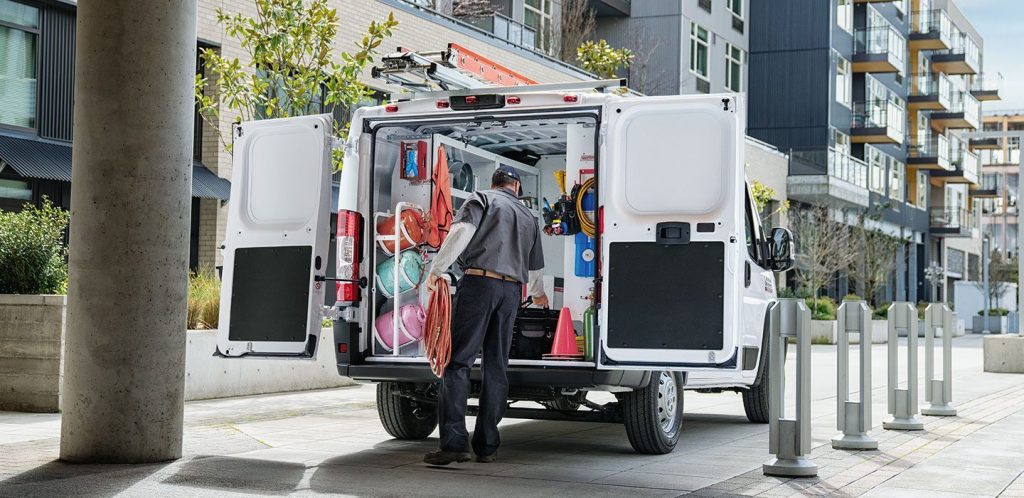
Ram ProMaster Interior | Ram Trucks
You can’t drop anything out of the enclosed space that a van offers. That means no damaged goods and the elimination of the liability of unexpected road hazards. There’s also the fact that although you can build out a truck for overlanding or equip it with a nice tent, camper conversions are largely more practical in a cargo van. The vast protected box provided by the cargo area makes for a great living space for overland travel.
2. A more professional appearance
There’s no denying that most pickup trucks look infinitely cooler than a cargo van. However, if you are using your truck for commercial use a cargo van is probably a more professional option. In terms of appearance, trucks are more fashionable.
A cargo van will look more commercial on the job. First impressions mean a lot, and the highly professional and undeniably commercial styling of a cargo van may go a long way in terms of branding. For commercial use, a cargo van looks a lot more professional. They just have a more business-designated feeling in the eyes of the customer.
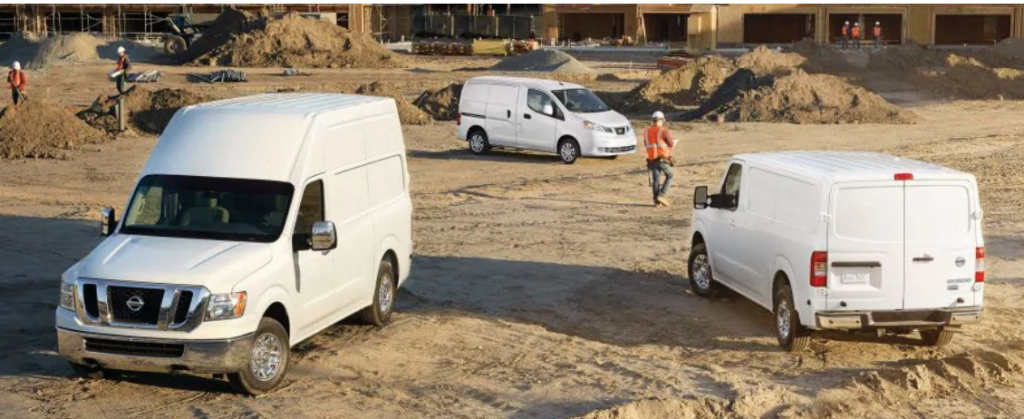
Nissan Commercial Vans | Nissan
3. You don’t have to forgo a long list of options
Pickup trucks are loved for their rugged looks and strong capability. They are also appreciated for the incredible amount of options buyers have to choose from when choosing a truck. While there aren’t as many different brands that offer a cargo van, the ones that do offer the vans in a wide variety of options and configurations for your business needs.
The Ford Transit and the Mercedes-Benz Sprinter both come available with factory 4×4. Additionally, the Transit now has a crew cab option. The Nissan NV and the Ram ProMaster don’t come with the 4×4 capability, but they do offer several different wheelbase and roof height options. Plus, they come in the 1500, 2500, and 3500 classifications just like a pickup truck.
Cargo van or pickup truck?
Cargo vans and pickup trucks serve many of the same purposes. Pickup trucks are inarguably more stylish and come with the possibility for luxury trim levels a cargo van would never even dream of. But they are also workhorses.
When it comes to choosing the right commercial vehicle to serve your business, the choice between buying a pickup truck or a van can be a hard one. Pickup trucks are awesome and you can’t argue that they possess more style and attitude. On the other hand, cargo vans are very utilitarian and offer up many compelling reasons business owners might be on the fence about choosing a pickup truck instead.
While each segment provides different things, they are both workers at heart. But which is the better commercial vehicle? Here are three reasons pickup trucks are better than work vans.
1. They are cool enough to lead a double life
Most people out there don’t want to drive around the commercial fleet van all day on the job and then take it out to dinner, too. A pickup truck on the other hand can lead a double life. The right pickup truck will offer the utility needed for your business and then get cleaned up and go out on the town. Much like the drivers of such a truck, these pickups are only good for one thing.
A pickup truck can look great in the city and then wake up in the morning, put its hard hat on, and get down and dirty. If you are worried about having a vehicle that is designated for the business, you can always slap a sticker on the doors to lend a more professional appearance. This is one good reason that a pickup truck is better.
2. Higher payload and towing capability
While cargo vans are very robust in their abilities, there aren’t any that can haul a load over 10,000 pounds. For a Chevrolet Silverado or a Ford F-150, this is just another day in the life. If you will be consistently heavy hauling and towing 10,000 pounds or more, get a pickup truck.
Each configuration offers different capabilities, just like the cargo vans. However, pickup trucks are undeniably stronger and more adept at handling a heavy load. While pickup trucks and work vans share DNA, they each evolved quite differently. Trucks are more capable in terms of hauling and towing and there’s just no getting around it.
3. More widely available 4×4
Another reason many turn to the pickup truck over a work van is there are many more with 4×4 capability. For many people, getting to the job means driving on a dirt or gravel road. While a couple of the vans offer available 4×4, every pickup truck offers 4×4 on at least one or more trim.
If you need a commercial vehicle with more off-pavement or off-road capability, a pickup truck is better than a commercial van. Properly equipped, pickup trucks offer the cargo utility plus the rugged capability of an all-terrain vehicle. If your business needs a vehicle to haul people and gear off the paved road, you’ll definitely want to choose a pickup truck instead of a cargo van. There are few things more counterproductive than getting stuck with your tires spinning in the dirt, your commercial vehicle loaded down with equipment for a job you can’t even get to.
Work van or pickup truck?
While both options are compelling in their own right, pickup trucks drive a strong argument in their case as commercial vehicles. We love cargo vans, but sometimes there are jobs that need the capability of a pickup truck. If you want something with more capability for heavy hauling or travel off-pavement, a pickup truck is the better choice. Plus, pickup trucks can double as both your commercial companion and a personal family vehicle.
Can Your Business Benefit From A Commercial Vehicle?
If you are a business owner, you may have wondered if adding a fleet of commercial vehicles is right for your business. Commercial vans can offer numerous benefits and be an essential part of your daily business routine. Whether you are a small local business or rapidly expanding, a commercial vehicle fleet may be right for your business. Discover the benefits of commercial vehicles and learn more about your commercial vehicle options.
Benefits of Commercial Vehicle Ownership for Business Owners
Adding commercial vehicles to your fleet is great for efficiency. Plus, you’ll enjoy tax write-off benefits at the end of the year. Many of the costs of maintaining a commercial fleet, even if the fleet only contains a couple of vehicles, can be written off at the end of the year. Depreciation, mileage, and interest on your auto loan can be written off as a tax deduction.
Another great benefit of commercial vehicle ownership is that commercial vehicles are built specifically to match your business needs. Commercial vehicles like cargo vans can help you stay organized while making deliveries and commercial pickup trucks are designed to help tackle the toughest job sites. Having commercial vehicles can help increase efficiency just by having everything organized.
Commercial Vehicle Options for Different Types of Jobs
Whether you are a general contractor, farmer, or other small business owner, you can have the commercial vehicle that meets your needs. You can browse cargo vans, haulers, pickup trucks, passenger vans and more. Search Ram commercial vehicles, like the Ram 3500 and Ram 4500, and take a look at our cargo vans, like the Ram ProMaster 3500. Whether it is Platform, Service, Utility, or cargo, you can find it in inventory. Start browsing commercial trucks and vans.
A van build is a large project that requires extensive research, detailed planning, and implementing a comprehensive layout design. A helpful suggestion is to break down the van build by phases and just focus on one phase at a time. If you do look at an entire van design outline from start to finish, it can be extremely overwhelming. However, the one thing most vanlifers can agree on is that sound-deadening and insulation is a great place to start. It is nearly instant gratification because there is no drying or waiting process involved. As soon as the camper van insulation and sound-deadening materials are installed, you’re able to immediately get up and drive your van around!
Sound-Deadening
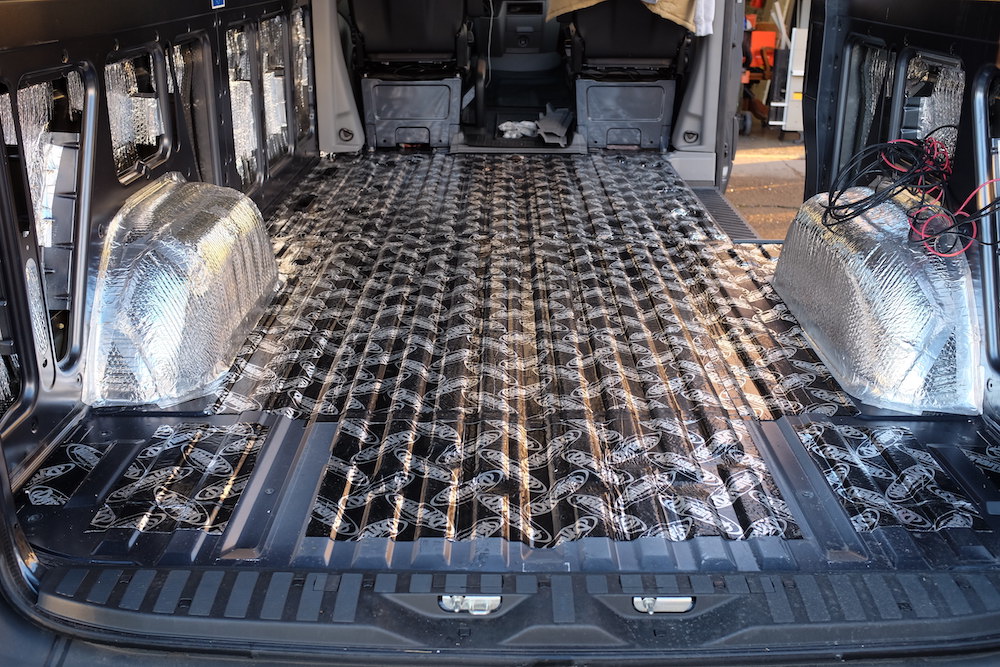
One of the first noticeable features of an empty, pre-converted van is the way that it echoes like a tin can. When you first drive your van after purchase, you may notice all the rattling of the metal. Even when parked, an empty van can echo like a tin can. Recognizing how hard it will be to make phone calls, whether to friends and family, or business calls, in an echoing van is important. From there, you can decide whether you think this is something worth fixing. Dynamat is a very simple solution, although there are many other options as well: FatMat Rattle Trap, Noico, and Kilmat.
All this material requires for installation is cutting it with a utility knife, peeling off the back paper, and sticking it on the necessary areas. Some people choose to place sound-deadening material only in certain regions, such as focusing specifically on the front cab, which will really help with noise and rattle comfort when driving. Further down the road, this will also help keep noise inside the van (during movies, conversations, etc.) as well as keep any exterior noise outside of the van.
If you’re lucky, your van might even come with sound-deadening materials at the time of purchase!
Camper Van Insulation
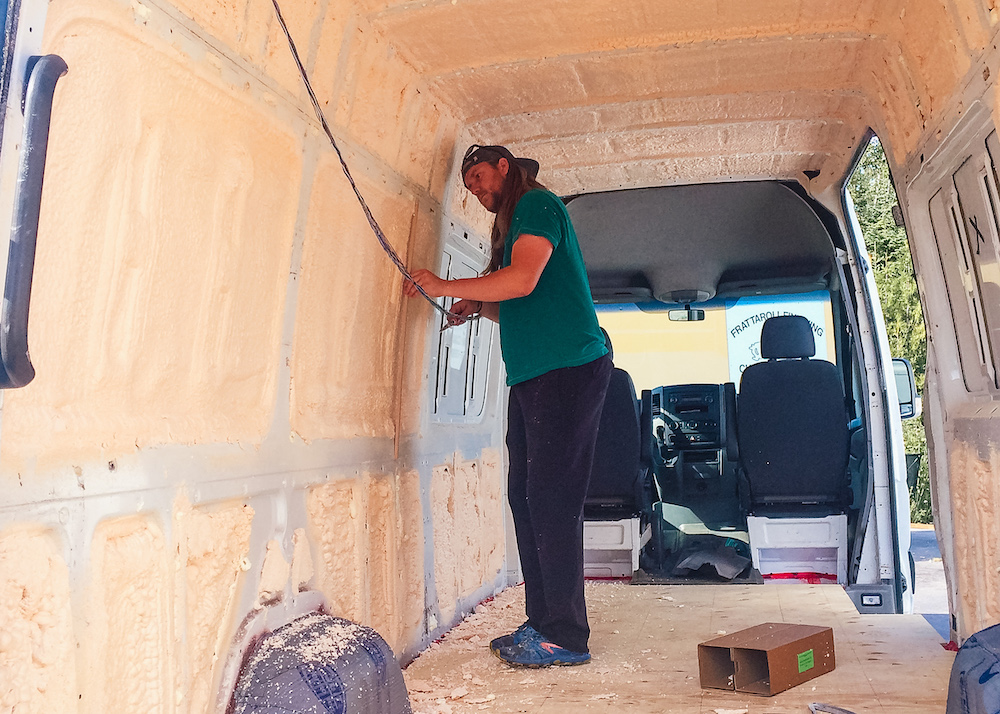
There are an endless amount of options for van insulation. The number of windows you have will also heavily influence what kind of insulation you use and how much insulation you need to properly ensure your van will stay warm or cool. Some swear by spray foam, while others swear by rigid foam board. The different options have various benefits and downfalls. For example, spray foam is extremely messy and is oftentimes recommended to have professionally installed in order to avoid a mess. Reflectix is nice for smaller regions, and rigid foam board is great for straight, flat areas, such as insulating the ceiling or floors.
A personal preference is to primarily use camper van insulation that you can stuff and squeeze into smaller spaces, as most vans have different compartments and sections that are hard to fit exactly. Some options here are fiberglass insulation or recycled denim batting. You’ll want to keep in mind that fiberglass may be harmful to breathe over time. Don’t be afraid to mix and match! Certain forms of insulation are better for certain areas of the van. Our preferred combo? A mix of recycled denim batting, rigid foam board, and reflectix. Here is a breakdown of the different kinds of insulation available with detailed pros and cons for each.
Spray Foam
While spray foam is considered one of the most efficient forms of camper van insulation, it can be very challenging to install. Nearly everybody I’ve ever spoken to agrees to this fact: if you plan on using spray foam to insulate your van, pay to have it done professionally. Additionally, closed-cell spray foam does a better job sealing all air gaps and gives you the highest R-value per inch.
One of the many reasons that we recommend having spray foam installed professionally is because of the above-mentioned metal warping.
Additionally, we have heard horror stories of spray foam leaking into certain areas of vans, such as seat belt devices, and having to wait on expensive replacement parts for the van that were not intended to be replaced. Make sure you tell the professionals completing your installation of any cavities you don’t want filled. For example, map out where your windows will go and share this information, and provide door and seatbelt mechanism locations as well. Taping off or sealing certain areas yourself, such as the cab of your van, may help ensure a clean job and less potential of finding foam in unwanted areas.





 Commercial Van Solutions