5 Tips to Help Select the Best Commercial Van Floors for your Vehicle
Protect Your Van’s Floor with a High-Quality Flooring Kit
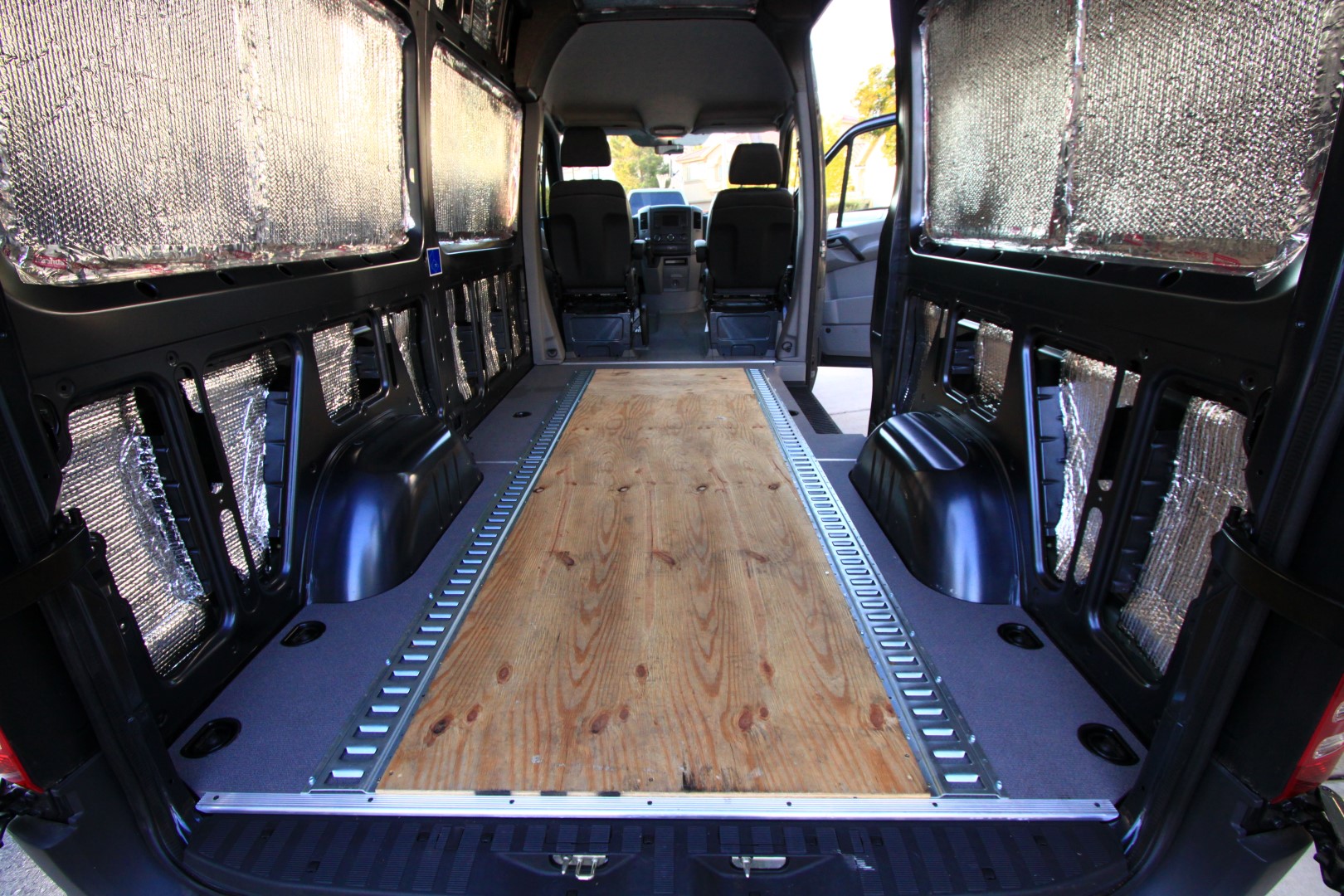
A high-quality cargo van flooring kit will protect your commercial van floors. Rigid and strong, a van liner protects the floor from scraping, dents, impacts, scratches and spills. Avoid the hassle of making a do-it-yourself floor. You can buy a heavy-duty floor system that’s made to perfectly fit your service van.
Make Sure Your Employees are Safe
A good floor kit also minimizes the chances of your employees slipping in the cargo area. It also helps to prevent cargo from shifting around. Impact and Puncture Resistant high-quality van flooring kits provide added safety and a quieter ride.
Select a Surface that is Easy to Clean
A good stable floor gives your technicians a durable surface to work on that is also easy for them to clean. Look for van floors with a non-porous surface that are liquid-resistant to eliminate bacteria and mold formation.
Always Look Professional
Give your work vehicle a clean, professional look that is easy to maintain. Commercial van floors that have aluminum sills add a nice finishing detail, and they give a crisp look to the van floor covering.
Choose Van Floors that are Durable
You will probably want van floors that are made of very high quality, eco-conscious rubber and are guaranteed for the entire time you own your vehicles. You can choose from rigid floors and extremely rigid floors. The best van flooring systems are built to resist cracking and splitting.
Ideal for Fleets
By installing sprinter commercial van flooring in combination with other accessories , your vehicles will have the most complete and professional look in vehicle upfitting. Don’t forget, a quality flooring system will enhance the resale value of your vehicles at lease end.
Fleet safety has never been a more pressing issue. Besides costing businesses millions of dollars in liability, fleet accidents can leave drivers traumatized and give companies a bad reputation. That is why fleet managers make it a priority to protect their drivers on the road and during jobs. Fortunately, with the rise of modern technology, more and more driver safety devices are becoming available on the market. Below are just a few of the tools you can invest in to build a safer fleet.
1. Track the position of your commercial fleet
Global Positioning Systems (GPS) and Automatic Vehicle Location (AVL) are tracking devices that can be installed in all the vans in a fleet and are connected to either a website or a company server. GPS and AVL allow managers to track the progress or position of vehicles while they’re out on the road. Both systems can also monitor how the vans are being driven, generating alerts if a driver is speeding or braking harshly. Not only are GPS and AVL designed for fleet safety, but they can also be extremely practical. Traffic headquarters can use these tools to determine drivers’ whereabouts and give customers an accurate ETA
2. Increase fleet safety with in cab video
In cab video is highly effective for helping prevent road accidents. It enables fleet managers to oversee the habits of their staff and ensure they are driving as safely as possible. On the driver’s end, in-cab video provides an incentive to drive more carefully. The cameras can be used to provide evidence if someone is suspected of driving dangerously, for example, or to help identify the cause of a collision to help prevent future accidents.
3. Equip your fleet with emergency buttons
Although emergency buttons are used mainly in public transport vehicles, they can be implemented in large fleets as well. The emergency button is a simple device that installs on a vehicle’s dashboard. In the case of extreme emergencies, where the driver may be alone and injured, pushing the button will immediately alert traffic headquarters, or even the police. The emergency button can also be linked to an AVL system, making it easy to pinpoint a van’s exact location, so that authorities can reach the driver as soon as possible.
4. Monitor your vehicle maintenance
Installing maintenance monitoring technology fleet-wide, generates up-to-date reports on the condition of the commercial vans. These types of systems can be connected to a computer or even downloaded in the form of a mobile app. They generate warnings in the case of serious engine problems and other vehicle issues so that the trouble can be fixed before it can escalate. Maintenance monitoring tools can help prevent accidents, as they reduce the likelihood of vehicles breaking down unexpectedly. They can even be programmed to signal when a van begins to run low on fuel. All in all, van maintenance tools can help drivers avoid mishaps on the road, as well as cutting back on potential repair costs.
5. Ensure up-to-date communications
It’s imperative that drivers always have a direct line of communication with traffic headquarters. While radio systems have been used in the past, modern in-vehicle computers are a much more effective form of interaction. They ensure that drivers are connected to the office at all times and able to inform headquarters immediately of any trouble. They can also be used by the traffic office to issue weather warnings to individuals or even groups of drivers to re-route them around congestion and road blocks. Similarly, drivers can communicate with other vans to alert one another of potential obstacles, or requests for help.
Stay Safe with Ranger Design’s Commercial Vehicle Safety Equipment
As a mobile technician, what is your greatest asset? Some may say your commercial vehicle or high-quality tools, and these certainly would be important. However, YOU are your greatest asset! And with this in mind, it’s important to think ahead to ensure you’re doing all you can to stay safe. Here are a few examples of safety equipment such as partitions, Flettner vents and alurack ladder rack, that increase well being while driving or on the job:
1. Install a Partition for a Safe Ride:
With so many tools and heavy-duty materials in a commercial vehicle it’s imperative to guard yourself with effective safety equipment in the event of a crash. In a collision even a light object can become a missile, projecting forward at a speed of 20 mph. Being struck with that kind of force could easily be fatal which is why every cargo van needs to be upfitted with a partition. Contoured, sliding door or clear view, there’s a partition built to suit your every need.
2. Keep the Air Fresh in your Cargo Van with a Flettner vent:
Driving and working in your commercial vehicle all day can quickly heat up the air space in your van. Breathing stale air over a long period of time can prove unhealthy, especially if it’s mixed with other fumes such as gasoline or diesel. The product most used to keep the air fresh is the Flettner vent. Made to push toxic air out and fresh air in, it’s a simple solution to keep drivers healthy and awake on the road.
3. Get a Max Step for Easy Access to your Cargo Van:
To be constantly stepping up into your commercial vehicle all day long, especially a high roof, can create unnecessary back strain and medical issues. Also, there’s always the chance of slipping and falling when stepping down out of the van. To make access to the van easier and less hazardous, Ranger Design created the Max Step. A durable rear step for all cargo vans, this piece of safety equipment is designed to eliminate accidents and offer tradesmen easier access to their cargo area.
4. Eliminate Back Strain with a Max Rack:
The job of a mobile technician is generally physically demanding, so whenever possible it’s good to get the right safety equipment to help prevent injuries. For contractors working with tall ladders, getting them down from the roof of their commercial vehicle can be a challenge. It was for this reason that Ranger Design created the Max Rack, a drop-down ladder rack designed to make loading and unloading of the ladder an easy job. With one simple movement the Max Rack brings the ladder down to the right height with minimal effort.
5. Light up your Work space:
Lastly, there’s no telling what accidents can happen inside a dark van. Fumbling around blindly through sharp, metal equipment for your tools is only asking for trouble. Cuts and bruises, if not worse, are inevitable. To reduce that risk it’s only smart for tradesmen to install lights in the cargo space of their commercial vehicle. Ranger Design offers inexpensive and quickly upfitted LED light strips for all vans, illuminating your work space and increasing overall safety.
Ranger Design Offers the Full Safety Solution for your Trade
The right safety equipment is key for all tradesman to have in their commercial vehicles. Take every precaution while driving or on the job, and treat yourself to a long and healthy life!
While Working On The Job, Protect Your Cargo Van From Tool Theft
With the high cost of equipment, a mobile technician’s worst nightmare is having his tools stolen from his cargo van. Tool theft is very common these days, and many tradesmen are affected by it. Luckily, there are helpful preventative actions that can be taken to ensure your cargo van and the equipment inside will be safe from crime!
Safe Environment for your Cargo Van
Keeping your cargo van in a safe environment is an easy way to prevent tool theft. Vehicle break-ins are less likely to occur if your van’s parked in a garage or behind a fenced-in area. Criminals want to steal things with the least amount of effort possible. Discourage them from trying anything by adding that little bit of extra protection. During the day while on the job, park your van somewhere you can keep an eye on it or where there are people. Chances of having your cargo van robbed in broad daylight and in front of eye-witnesses, are slim.
Cargo van Alarms
The next most obvious option is a car alarm. Every cargo van should be equipped with a standard burglar alarm however you may want an upgrade depending on the tools you carry. With the standard alarm, it goes off when the van windows break or the door is forced open. The more state-of-the-art alarms offer a broader range of anti-theft features. Some can even be connected to your phone and will alert you to a break-in no matter where you are.
Window Grills and Tinting can Prevent Tool Theft
Equipping your cargo van with window grills and a dark window tint is another great and inexpensive burglar preventative. If a thief isn’t positive that there are tools inside your van, they’re much less likely to risk breaking in. However, for the few who decide take the chance, it’s a good idea to have window grills installed as well. Even if they break the tinted glass, they’ll find themselves confronted with steel bars and still no access to the cargo space.
Locks and Partitions
Not only are safety partitions imperative in a crash, but they’re also great theft deterrents. A crook entering the cab of your cargo van will find his way to your tools blocked by a partition. However, a partition will not fully protect your van if your cargo area can be unlocked from the cab. To create a full barrier around your tools, install a separate locking system for the cargo space. With access to the cab blocked by a partition and the cargo doors locked up, you can create a perfectly secure spot for your equipment.
Dash Cams
Although dashcams are mainly used in the event of an car accident, they can also be helpful when it comes to cargo van break-ins. Not all of them shut off when the vehicle is parked. Many are motion sensitive and start recording when they detect movement. Even the sight of a dashcam could be a quick way to avert theft. And if it isn’t, there’s still a possibility that they get caught on film, giving you more of an opportunity at recovering your tools.
The first step is most crucial to the success of your up and coming small fleet. You need to consider the impact of running your own company and how you will best manage it. Below are some tips to bear in mind when starting up:
The Market. Be sure to spend time carefully researching the market niche for your small fleet. Learn your customer base and size up your soon-to-be competitors. It is important that you know what you are up against and that you have a strategy to build your own loyal customer base. Decide how you are going to get your name out there. If possible, use your vehicles like moving billboards. Plan to have your fleet vans wrapped and get your company name and logo out there on the streets. Projecting a good image to potential customers is extremely important.
Expenses. Make a detailed plan of your expenses and your projected profits. Some expenses may include the purchase of a new vehicle or business location. There will also be payroll taxes, worker’s compensation and insurance, and of course your employee’s wages and benefit costs. How much you are able to spend on start-up costs will determine the size of your fleet but don’t make the mistake of multiplying your profits by the number of vehicles. Expenses may outweigh the profits in the beginning however that should change as you break further into the market.
Management. Plan how you will manage your small fleet in the most efficient way possible. Think about your invoicing and filing systems. How will they be best managed so it is an easy process for you and your customers? Scheduling is also important. GPS tracking devices can be extremely useful for this. By knowing exactly where your drivers are at all times, this will allow you to schedule their next appointments and give your customers an estimated arrival time.
There is a lot of planning needed when starting up a small fleet of your own and it is a good idea to get a second opinion. Speak to a consultant or a friend who may have gone through the same thing. They will make sure nothing is overlooked and will have helpful tips to get you started.
2. Choosing the Right Vehicle for your Small Fleet
The next step is to choose the right cargo van to best maximize your potential. Take a look at the characteristics you’ll need the most in your fleet. Some factors include:
Price. Decide what are you willing to spend on your van. Do you want to buy it for the least amount possible in the beginning, and maybe upgrade once you are making a steady profit? Or do you want to bite the bullet and get a more expensive van that will last you for many years?
Fuel savings. Are you concerned with getting the best mileage possible? If you foresee your vehicles traveling over large distances daily, then a van with high fuel savings probably makes the most sense. Not only will you be saving money but you will also be making less of an impact on the environment.
Size. The size of your vehicle depends on your job. For fleets in a busy city, a smaller van makes more sense as it can fit into tight spaces and underground parking lots. However, it depends on what you will be using your vehicle for. If you plan to create a work station in the back of vehicle, then a high roof van is a much better option. Your employees will have the space to stand up without bending. The van size also depends on what you plan to carry. If you will be hauling skids, you need to make sure they will fit in your van and that they will not be heavier than the vehicle’s load capacity allows.
These are just a few suggestions to look into when choosing your fleet vans. Do some research on the cargo vehicles available and narrow them down to the one you think will meet your small fleet needs.
3. Van Equipment for Your Small Fleet Van
Lastly, choose an upfit for your small fleet vans. Having the right van equipment for your work is an important factor in keeping the tools in your vehicles organized and in keeping your employees safe. Here are some products that you might consider putting in your vehicle for a better work experience:
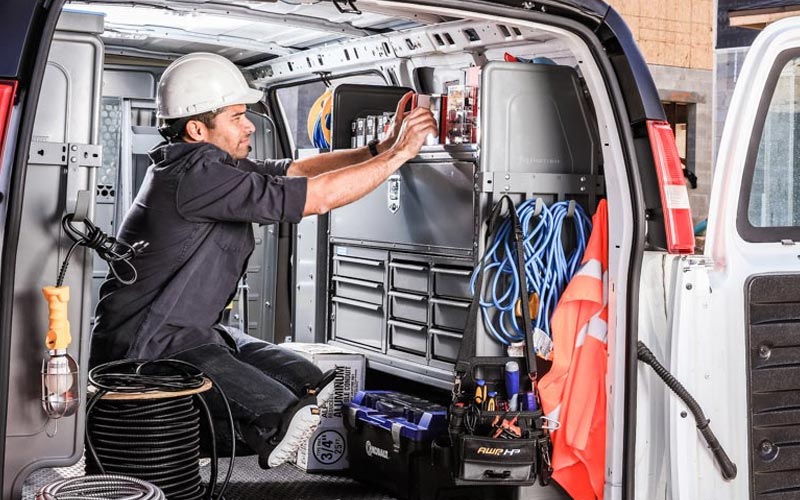
Shelving. Outfitting your vehicle with shelving is a smart choice. Instead of having all your tools rolling free in the back of the van, they can be placed neatly on the shelves. This will help keep everything tidy and decrease the amount of time your employees spend searching for their parts and equipment. Bins and dividers can also be purchased with the shelves to offer an individual spot for the smaller tools.
Partitions. If you plan to put tools and equipment in the back of your vehicle, then a partition is mandatory. Although most cargo vans are sold with an OEM version, you may want to upgrade to one that will better suit your needs. For example, if your employees will constantly be entering the back of the van, you will want a partition with a door. Partitions are there to keep your driver’s safe, so why not get the most use out of them as possible?
Ladder Racks. If carrying any sort of ladder in your fleet van, a custom ladder rack is absolutely necessary. There are many different types available out there to suit your needs. First, decide which type of ladders and how many each vehicle will need to carry. Then research the rack that will be the most beneficial. If your employees will be accessing their ladders many times during a day, maybe a drop-down rack is the best option to reduce strain. If you are transporting both ladders and additional materials, then a cargo rack would be ideal.
Health and safety. It is a number one priority while at work. And for tradesmen and commercial van drivers especially, now is the time to be extra careful while on the job. Follow the health and safety guidelines to ensure your cargo van stays clean and sanitary.
Keep the Air Fresh
Ensure that the air in your cab and cargo space is constantly moving, and not staying stagnant in your vehicle for long periods of time. One product that helps with this, is a Flettner vent. Installed on the roof of the commercial van, it sucks in fresh air as you drive while forcing the stale air out. This lowers the chance of germs settling on surfaces, reducing the risk of sickness.
Put Up a Barrier for Yourself
For commercial vans designed to carry passengers or materials that may be contagious, it is a good idea to put up a barrier to protect you. Composite safety partitions for cargo vans are a great option. Their tight fit to the van walls prevent germs from seeping into the cab while you drive. For smaller passenger vans, a clear plexiglass shield offers just as much protection and also allows the driver and passengers to see and hear each other clearly.
Clean Your Work Space Regularly
Giving your commercial van a quick clean, as often as required by company guidelines or government regulations, is a good way to rid yourself of germs and bacteria. However sometimes it can be difficult to wash the things you touch the most; your seat for example. That’s why we suggest Seat Covers. Sturdy and fitted, they are also removable which means you can throw them in the washing machine as needed.
Keep Protective Equipment Close
Hand sanitizers, gloves, masks… these are essential items to be carrying around in this current time. However, these are relatively small items which means they can be easily lost in the equipment of a commercial van. The solution to this is the 3-in-1 Sanitizer Caddy. This aluminum holder mounts anywhere in your van and stores all the essential items you need when coming into contact with other people.
Van Partitions for Your Commercial Vehicle and Your Trade
You cannot put a price on safety and that is an important point to remember when shopping for a van partition for your commercial van. The partitions are designed and tested to meet the toughest safety standards in North America. They are engineering for driver comfort and provide a quiet ride. Below we have outlined some of the benefits of each safety partition:
Straight Van Partitions
Designed for medium and high roof cargo vans, straight partitions are made from steel and offer no access from the cargo space to the cab. They are really made to offer you a solid barrier between you and your cargo. In the event of a crash, you will not be injured by any flying objects in the back of the van. The straight partition can also be used as a canvas for other accessories. By adding a few hooks or some paper holders, you can create an extra wall of storage in your commercial vehicle.
Walk-Through Van Partitions
Next up are walk-through partitions available in steel and aluminum. It makes sense to consider a walk-through partition when access to the cargo area is a priority, like it is for last mile delivery. There are several different styles – swing door, sliding door and direct walk-through. The swing door option is steel which is more economical for fleets, while the sliding door option is designed to be lightweight for reduced payload. Both these models are very popular for delivery vehicles and are made to latch as a theft preventative. Walk-through van partitions offer you a great combination of safety and accessibility.
Contoured Van Partitions – Large Vans
Contoured van partitions are a great choice if comfort is your number one priority. They are set back from the van’s B-pillar to allow for full seat travel and recline and are made from aluminum or composite material. The aluminum models are designed with either a perforated or tempered glass window for those of you who prefer to have a view into the back of your van. Our composite option is made from durable TPO with a tight fit that helps keep heating and cooling in the cab, and odors out. It also comes with a sturdy grab handle for extra accessibility when climbing in and out of your commercial vehicle.
Contoured Van Partition – Small Vans
Contoured partitions are really designed to give as much room in the cab and the cargo area, as possible. This is very useful in a small van, where space is already tight. If you are looking for something with a roomy feel, the Max View van partition is an excellent option. Not only does it give the driver more room, but it also makes the cab feel a lot more open with its clear polycarbonate top.
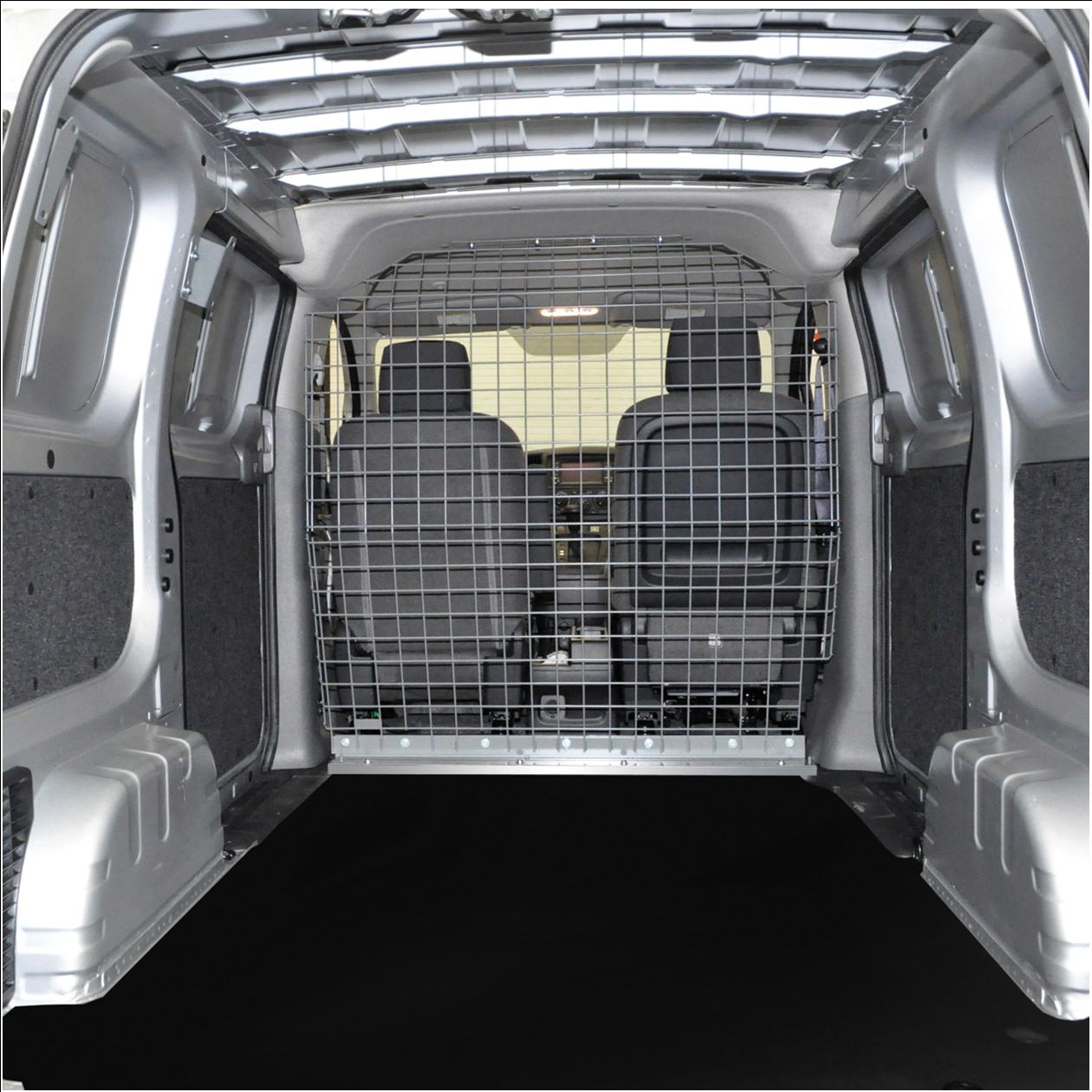
Another contoured option – probably the most economical choice – is the wire mesh van partition. It protects the driver while allowing air circulation in the van. The last option is our solid contoured van partitions made from steel or aluminum. They offer a solid barrier between the cab and cargo area, creating a more enclosed cabin for increased heating and air conditioning regulation. These contoured partitions are tough and durable and make a great choice for any small commercial vehicle.
You cannot put a price on safety and that is an important point to remember when shopping for a van partition for your commercial vehicle. Our partitions are designed and tested to meet the toughest safety standards in North America. They are engineering for driver comfort and provide a quiet ride. Below we have outlined some of the benefits of each safety partition:
Straight Van Partitions
Designed for medium and high roof cargo vans, straight partitions are made from steel and offer no access from the cargo space to the cab. They are really made to offer you a solid barrier between you and your cargo. In the event of a crash, you will not be injured by any flying objects in the back of the van. The straight partition can also be used as a canvas for other accessories. By adding a few hooks or some paper holders, you can create an extra wall of storage in your commercial vehicle.
Walk-Through Van Partitions
Next up are walk-through partitions available in steel and aluminum. It makes sense to consider a walk-through partition when access to the cargo area is a priority, like it is for last mile delivery. There are several different styles – swing door, sliding door and direct walk-through. The swing door option is steel which is more economical for fleets, while the sliding door option is designed to be lightweight for reduced payload. Both these models are very popular for delivery vehicles and are made to latch as a theft preventative. Walk-through van partitions offer you a great combination of safety and accessibility.
Contoured Van Partitions – Large Vans
Contoured van partitions are a great choice if comfort is your number one priority. They are set back from the van’s B-pillar to allow for full seat travel and recline and are made from aluminum or composite material. The aluminum models are designed with either a perforated or tempered glass window for those of you who prefer to have a view into the back of your van. Our composite option is made from durable TPO with a tight fit that helps keep heating and cooling in the cab, and odors out. It also comes with a sturdy grab handle for extra accessibility when climbing in and out of your commercial vehicle.
Contoured Van Partition – Small Vans
Contoured partitions are really designed to give as much room in the cab and the cargo area, as possible. This is very useful in a small van, where space is already tight. If you are looking for something with a roomy feel, the Max View van partition is an excellent option. Not only does it give the driver more room, but it also makes the cab feel a lot more open with its clear polycarbonate top.
Another contoured option – probably the most economical choice – is the wire mesh van partition. It protects the driver while allowing air circulation in the van. The last option is our solid contoured van partitions made from steel or aluminum. They offer a solid barrier between the cab and cargo area, creating a more enclosed cabin for increased heating and air conditioning regulation. These contoured partitions are tough and durable and make a great choice for any small commercial vehicle.
Why Buy a Van Ladder Rack for Your Commercial Vehicle?
Heavy Duty Aluminum Van Ladder Racks
Easy one person operation
Heavy duty rack construction & large carrying capacity (up to 600 lbs)
Rust free aluminum construction & ergonomic design (powder coated white finish)
Available in many styles for many types of vans (single, double, combination or drop down)
Van Ladder Racks are Essential for Successful Tradesmen
Van ladder racks help tradesmen overcome some big challenges to their day to day operations. A well designed rack can offer many advantages to the tradesman beyond just loading and transporting a ladder.
The stores have a number of different styles of racks that can help tradesmen free up valuable interior cargo space while helping them work more effectively and safely. All of our van ladder racks are made of heavy-duty aluminum and are contractor proven tough. They work hard and pay for themselves by helping tradesmen save time and money.
All van ladder racks mount to the roof of a van and allow the ladder(s) to be safely stored and transported on the roof. This frees up valuable interior space giving you more cargo capacity for transporting more equipment and materials.
Nobody likes to lose time and money due to injury. A van ladder rack can reduce the risk of injury making it much safer to load and unload a heavy awkward ladder. Once stowed up and out of the way, it is safely secured for transport around town and out on the highway.
Wasting time wrestling with a heavy ladder costs you money. Our van ladder racks are designed for simple one person operation. By making it much easier and quicker to load and unload a ladder, you save time. Repeat this process many times and day and it’s easy to see how our van ladder racks help you work more effectively.
Ladders and commercial vehicles are expensive. Having to replace a damaged ladder or repairing vehicle bodywork adds to the costs of operating your business. You can protect both a ladder from damage and your vehicle’s exterior finish from dents and scratches with a well designed rack.
Whether you’re driving a Mini Cooper or a full size cargo van, one of the easiest ways to increase your adventure capabilities is to add a roof rack. While a roof rack isn’t always needed, if you want to carry large, bulky items like kayaks or roof top tents, or even smaller items like bicycles on smaller vehicles, roof racks are often the way to go. But to get there, you’ll have to start with the basics, like:
How can I put a roof rack on my vehicle?
There are a number of ways you can add a roof rack to your ride, but the ‘how’ will depend on your vehicle. There are essentially five categories when it comes to roof top accessories:
a completely naked roof
a naked roof but with factory mounting anchors
roofs with tracks
roofs with a factory rail system
roofs with factory rails and crossbars.
If your vehicle has a factory rail and crossbar set up, this can often be the easiest to accessorize – though they often have limitations in terms of weight capacity and compatible accessories. Because of this, you may opt instead to remove the factory cross bars and add a pair of Yakima, Thule, or other crossbars in order to increase the weight capacity and compatibility. In this case, it’s best to consult the vehicle manufacturer to find out the factory rack’s weight limits before deciding how to approach it.
The factory cross bars are usually best for the addition of roof top boxes or single bike mounts which will give you extra storage space for gear without adding a lot of weight.
It’s a similar story if your vehicle has raised side rails from the factory. You’ll want to head to Yakima or Thule’s website and use their fit finder to find the compatible tower and then choose your cross bar. Again, this set up may be limited to a certain weight which will only really become an issue if you want to install something like a rooftop tent and other accessories. Most brands will sell a specific tower that will fit your vehicle’s factory rails, and then the tower holds the aftermarket cross bar in place.
Without a factory rack of any sort, there are still a ton of options to install a roof rack. Both Yakima and Thule sell multiple tower systems that either use specific clips or fit kits for the naked roof of your vehicle, or they sometimes will mount directly to hidden factory mounts in the roof. Most of these systems are available for many different vehicles, all without permanent modifications to the roof. If you lease, plan to sell in the near future, or just don’t want to drill holes in your roof, this is the best course of action.
Why Are Vandwellers Choosing The Sprinter Camper Van?
More and more full-time vandwellers, people living the weekend warrior life and outdoorsy people are choosing the sprinter camper van as their adventure bus. And we can see why, we’ve already shown you some amazing Mercedes sprinter conversions such as the Mercedes Benz Sawtooth conversion, the sprinter conversion moving house and the Sith-style conversion that lets you live the Darkstar van life. So why are so many van life influencers and adventurers choosing the sprinter van over a more traditional RV or something like an airstream camper to be their tiny homes? Read on, and we’ll tell you why.
Why Choose a Sprinter Camper Van?
When you think of sprinter van, it’s likely that a white, dirty and slightly battered builders van is going to come to mind. A workhorse, something practical, durable and reliable, but not something that you’d want to sleep in. However, it is these qualities that make the idea of a sprinter camper van so attractive. The Mercedes makes a practical camper van as it’s so easy to drive. No more struggling up hill or getting stuck on a tight, twisty country lane. No more dreading the drive and just wanting to get to your camping spot as quickly as possible because driving a sprinter camper van is like driving a car, only without the rear view mirror!
Sprinter work van are durable, they’re known for driving hundreds of thousands of miles without a problem. Having a reliable van is so important, and this is another point in favour of the sprinter camper van. Sprinter vans are a globally recognised vehicle, Mercedes produce their cars and vans all over the world, and there is a reason for this, they’re good. Years of experience means they create the best and most popular van there is to offer, so it makes sense to turn it into a camper.
This also means that if you have any problems while travelling in your sprinter camper van the chances that you’re going to be near a Mercedes garage are pretty high, and if not, most garages will stock any parts you might need anyway.
Sprinter Camper Van Interiors
There is another reason why the sprinter camper van is seeing a recent surge in popularity, and it has nothing to do with the mechanical excellence of Mercedes sprinter camper conversions, or anything to do with how safe and easy sprinter vans are to drive. It is because the sprinter camper van is just, well… cool. More and more young people want to get outside, to step away from their computers and TVs and to breathe in the fresh air, discover new places and take in amazing views.
Adventuring, exploring and, along with it, ‘motor-homing’ is so desirable right now but motor-homing sounds too old fashioned, too much like something your grandparents would do. So in comes ‘van life’ and, at the heart of it, the sprinter camper van. Van life is so effortlessly cool right now but young adults wanted something different for their off grid adventure than the large, beige, ugly old-fashioned motorhome and they chose the sprinter camper van.
From the outside, the sprinter camper van is understated and sleek, usually keeping its original working van’s colour of black, white, silver or navy blue. You may come across a unique camper conversion where the outside of the van is a bright, bold colour such as red or yellow, either resprayed or from the vans previous life. And occasionally you’ll see a flawlessly decorated sprinter camper depicting scenes of previous adventures- a mountainscape for example, on the van’s exterior.
What you won’t find on a sprinter camper van are tacky, peeling decals that haven’t stood the test of time and look out-dated and uninviting. The sprinter camper van is too cool for that. Windows and skylights can also be added to any sprinter camper van, either standard ones that come with the vehicle in the side and back doors or something different and personal to your tiny home. Windows bring so much light into the van and make the interior feel so much bigger, but they can also look cool from the outside. Portholes are a popular choice that makes the sprinter camper van look unique from the outside and give the interior a nautical feel.






 Commercial Van Solutions